Tachograph regulations govern driving hours, rest periods, and break requirements for commercial vehicle operators across Europe. Understanding these rules is essential for fleet compliance and driver safety.
Tachograph Basics
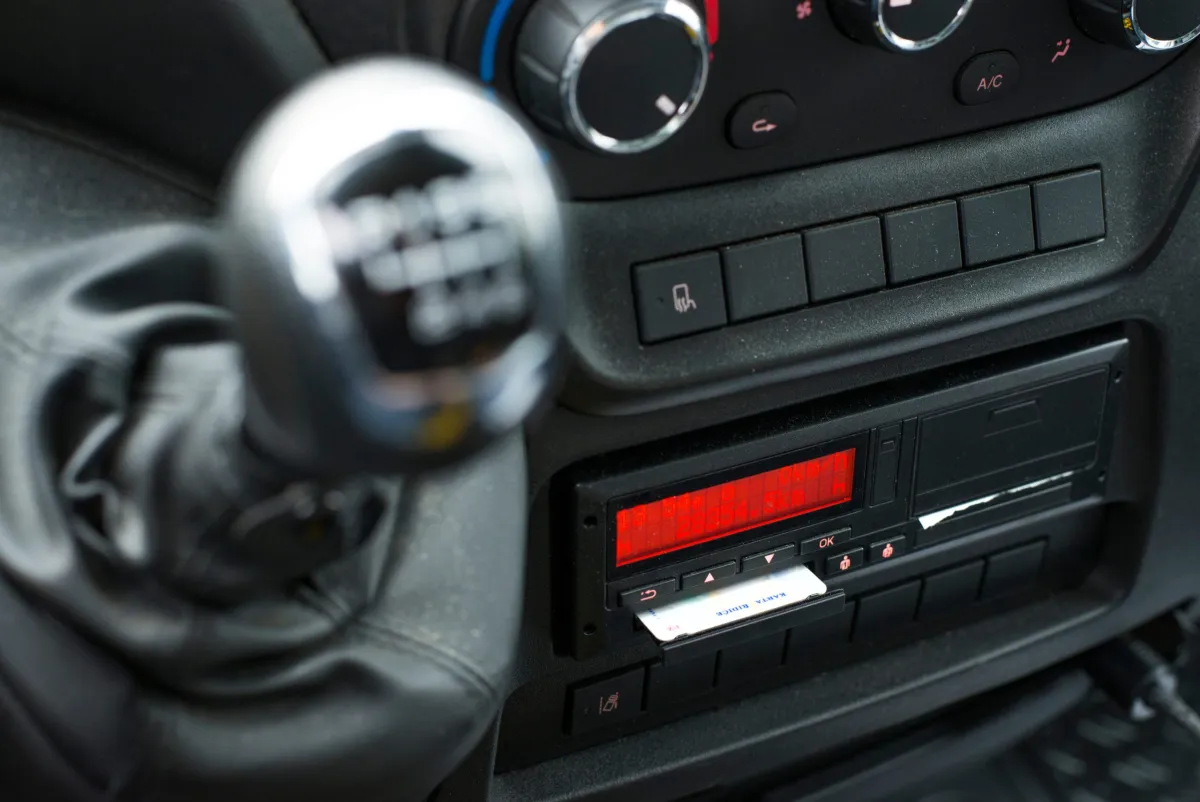
A tachograph is a monitoring device installed in vehicles to record driving hours, speed, and rest times. It exists in analogue form (using paper disks) and digital form (storing data electronically on driver cards). Tachographs must be installed in vehicles weighing more than 3.5 tonnes that cross borders, as well as in new vehicles designed to carry more than 9 persons including the driver when used for passenger transport.
Digital tachographs have largely replaced analogue versions due to their reliability and efficiency. The driver card system eliminates paper charts, reduces tampering risks, and simplifies data archiving. Smart Tachograph 2 enables remote enforcement checks, allowing authorities to detect violations without stopping vehicles.
Core Driving Time Rules
Drivers must follow strict limits to reduce fatigue and ensure fair competition:
- No more than 4.5 hours of continuous driving without a break
- Maximum 9 driving hours daily (extendable to 10 hours twice weekly)
- Weekly driving must not exceed 56 hours; total over two consecutive weeks must not exceed 90 hours
Break and Rest Period Regulations
Break requirements are designed to prevent driver fatigue:
- After 4.5 hours of driving, a 45-minute break is required (can be split as 15 and 30 minutes)
- Regular daily rest of at least 11 hours (reducible to 9 hours three times between weekly rest periods)
- Weekly rest periods must be at least 45 hours; reduced rest of 24 hours is allowed once every two weeks if compensated later
Special Scenarios and Exceptions
- Double-manning: Two drivers operating one vehicle can alternate, with one resting while the other drives
- Ferry or train transport: Rest periods can be interrupted for boarding and disembarking, provided total resting hours meet regulatory minimums
- Emergencies: Drivers may deviate from rules if reasons are clearly documented and reported
Digital Tachograph Compliance
- Driver cards require downloads every 28 days; vehicle units every 90 days
- Records must be stored for at least 12 months
- Cloud-based platforms streamline automatic downloads, archiving, and compliance report generation
EU vs AETR vs UK Tachograph Rules
The EU and AETR share identical driving time, break, and record rules. The UK, following Brexit, maintains aligned tachograph rules labeled as "assimilated," though variations exist in retention periods and enforcement processes. The AETR agreement covers non-EU countries including Switzerland, Norway, and parts of Eastern Europe, ensuring consistency across wider Europe.
Tachograph Compliance with Ruptela
Ruptela's HCV5 and HCV5 Lite GPS trackers support efficient remote tachograph data management, allowing downloads of .ddd, .tgd, and .v1b files without manual intervention. These devices are compatible with major tachograph brands (EFAS, Stoneridge, and VDO) and offer additional fleet features including eco-drive monitoring and driver behavior analysis.